

DISCOVER UNIQUENESS
The Letter That Should Never Have Been Ignored

At the beginning of 1913, the British mathematician Godfrey Harold Hardy received a letter from Madras, in southern India. There was nothing unusual about it. Cambridge frequently received manuscripts from enthusiasts convinced they had discovered new mathematical laws or solved impossible problems. The vast majority were forgotten after a quick reading. Hardy was used to distinguishing, almost at a glance, genuine insight from fantasy. That morning he opened yet another envelope. Inside he found several pages covered with formulas. Almost no explanations. No proofs. No references. Only extraordinary results. For a few minutes he thought he was looking at a fraud. Then he realised that those expressions contained a depth that simply could not be faked. Years later, he would remember that moment with a sentence that became famous: “Either this man is a fraud… or he is a genius unlike any I have ever seen.” That single letter would change the history of mathematics forever.
The person who had written it was neither a university professor nor a researcher, nor did he belong to any prestigious institution. He was Srinivasa Ramanujan, a young Indian man of barely twenty-five who worked as a modest administrative clerk to support his family. From a very early age he had developed an almost obsessive fascination with numbers. While other students followed conventional academic programmes, he spent hours exploring mathematical relationships driven purely by curiosity. His life changed when he came across an old book by George Shoobridge Carr, containing thousands of identities and theorems with almost no proofs. For most people it would have been nothing more than a reference manual. For Ramanujan, it became a challenge. He decided to reconstruct every proof on his own and, once he had done so, he continued beyond the book, discovering new paths where the text had nothing more to say. Without specialised teachers, major libraries or significant financial resources, he gradually developed a completely personal way of thinking about mathematics.
When Hardy decided to invite him to Cambridge, the world discovered that many of those seemingly impossible expressions were correct. Some would take decades to be rigorously proved. Others are still used today to understand problems related to number theory, physics and cryptography. Ramanujan died at the age of only thirty-two, yet his notebooks continue to inspire research more than a century later. His story shows that the most valuable knowledge can emerge far from the places where we normally expect to find it.
Up to this point, this might simply seem like the biography of an extraordinary mathematician. But I believe something much more interesting is happening. Every time I reread his story, I have the feeling that I have come across it before. Not in another mathematics book, but in the science fiction novels and films I have been reading since I was a child. Because although the settings, the planets and the technologies may change, the underlying question always remains the same: what happens when someone appears who is capable of seeing what nobody else can understand?
In Good Will Hunting, we find almost exactly the same pattern. Will works cleaning the corridors of MIT. Ramanujan lived a modest life as an administrative clerk in India. Neither possesses the résumé the system expects. Neither seems destined to change an entire discipline. Yet both hide an extraordinary ability to solve problems that astonish the world’s leading specialists. What truly changes everything is not their talent. It is the fact that someone chooses to recognise it. Hardy does for Ramanujan exactly what Professor Lambeau tries to do for Will: he understands that some people appear in the most unlikely places and that the greatest mistake is failing to recognise them.
Science fiction takes this very same idea even further. In Ender’s Game, humanity is not simply searching for the smartest child. It is searching for a different way of thinking. Outstanding academic records are no longer enough when the enemy behaves in a completely unfamiliar way. What is needed is someone capable of breaking patterns, questioning assumptions and finding solutions that no manual had ever anticipated. In the end, Ender succeeds not because he has more information, but because he looks at the problem from a different perspective. Exactly as Ramanujan did when he wrote formulas that no mathematician could explain.
Something similar happens in The Three-Body Problem. The story revolves around phenomena that challenge everything science considers possible. The protagonists make progress because a handful of scientists dare to pursue relationships that remain invisible to everyone else. Mathematics ceases to be merely a tool for calculation and becomes a language capable of revealing hidden structures of the universe. That idea feels profoundly Ramanujan-like. The greatest discoveries begin when someone recognises a pattern where everyone else sees only noise.
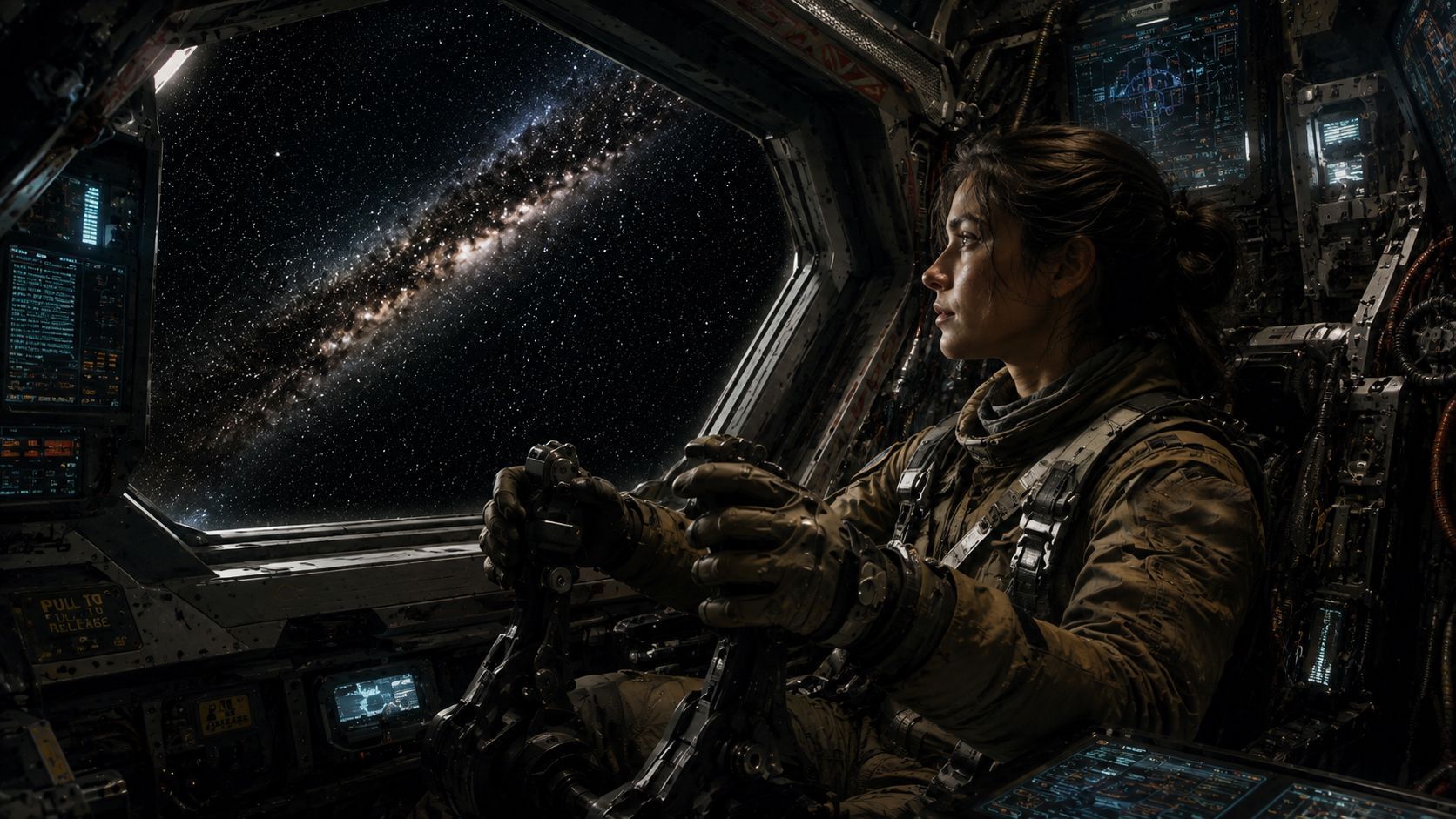
Even Sunshine, a film apparently centred on a space mission, ultimately defends the same intuition. When the Sun begins to die, humanity depends not only on engines, spacecraft or technology. It depends on people capable of interpreting completely new situations and making decisions for which nobody has ever been prepared. Science fiction returns again and again to the same conclusion: the greatest challenges are not solved simply by having more resources. They are solved when someone appears who is capable of understanding the problem in a different way.
Perhaps that is why these stories continue to fascinate us. Not because they speak about the future, but because they speak about us. They all begin with the same deeply human hope: the belief that, whenever an apparently impossible problem appears, someone will be able to see it from an unexpected angle. A young mathematician in India. A janitor in Boston. A child trained to save humanity. Or a group of scientists trying to understand a universe that seems to escape all logic. The settings change, but the question remains the same: how do we discover those who can contribute something that nobody else can?
It is precisely here that psychology begins to provide some answers. For decades we have tried to measure talent through examinations, academic degrees and standardised tests. However, Howard Gardner challenged the idea of a single intelligence and showed that human abilities take many different forms. Ellen Winner observed that exceptional talent often reveals itself through an unusual intensity and curiosity that can initially seem uncomfortable. Scott Barry Kaufman argued that true personal development consists of discovering what makes every individual unique. Carol Dweck reminded us that this potential requires an environment capable of recognising it and helping it grow. And Robert Sternberg demonstrated that analytical, creative and practical intelligence represent different capacities, all of them essential for facing different kinds of problems.
Ramanujan brought many of those qualities together in a single individual. But his story also reminds us of something much closer to home. Each of us possesses a unique way of seeing the world. The real challenge is discovering it before spending a lifetime trying to become too much like everyone else. Too often we invest enormous effort trying to correct our differences when, in reality, those very differences may contain our greatest contribution.
Perhaps that is why I keep thinking about Ramanujan every time I finish a great science fiction novel. Because the greatest heroes of the genre rarely save the world through strength or power. They do so because they are capable of making connections that nobody else had imagined. Long before there were Ender Wiggin, Will Hunting or the scientists of The Three-Body Problem, an unknown young man wrote a letter from India and proved that this possibility did not belong to fiction.
It was completely real. That is why you should discover what makes you unique.