

BUILD LEGACY
The greatest works are never truly finished. They continue to grow
“The great book, always open and worth striving to read, is the book of nature.”
— Antoni Gaudí
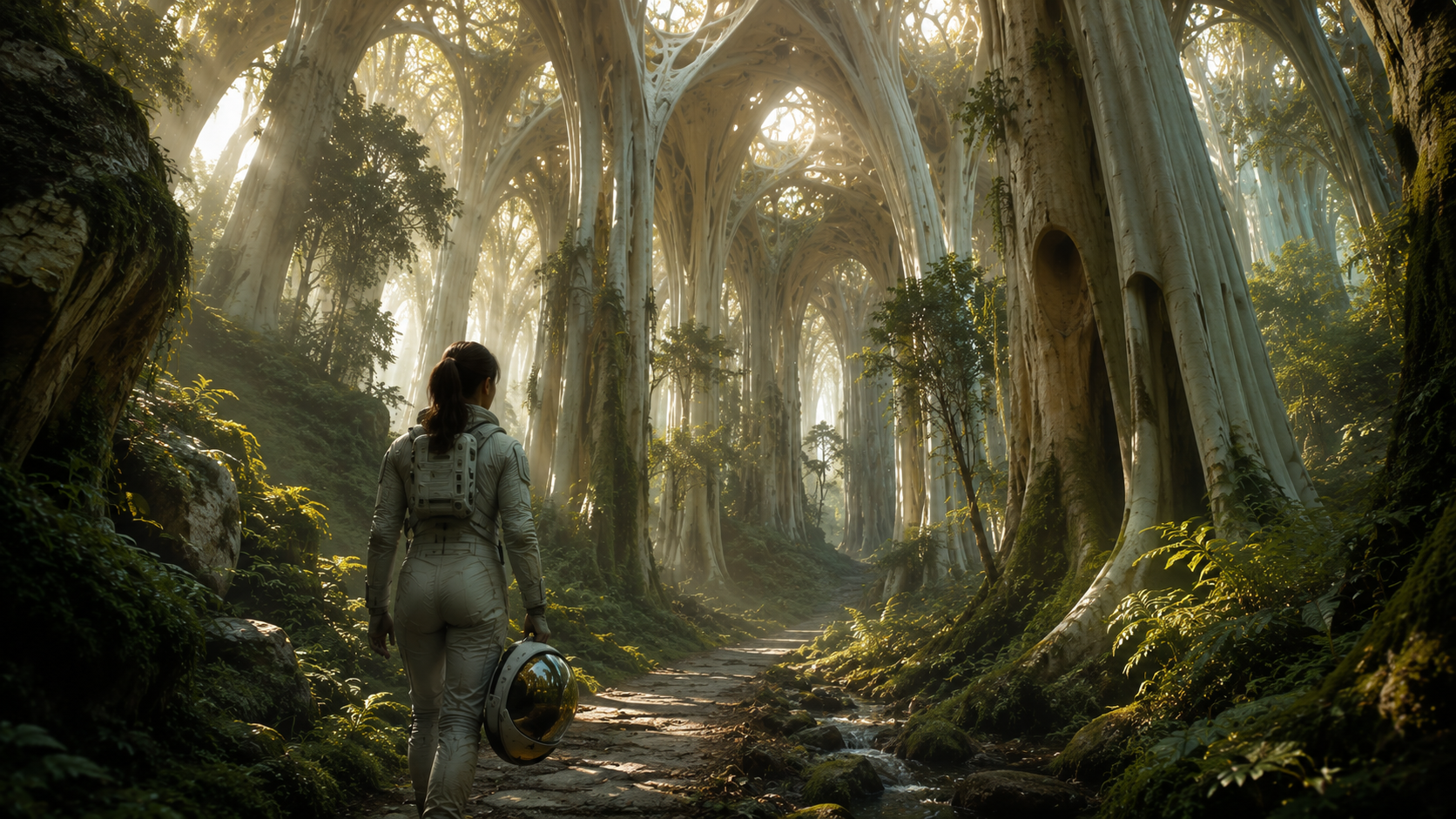
For a long time, Antoni Gaudí was regarded as one of the most original architects in history. Yet the more his work is studied, the clearer an unexpected idea becomes: he never wanted merely to construct buildings. He wanted to understand how nature builds. One only has to step inside the Sagrada Família to begin to understand it. Its columns rise like tree trunks reaching for the light, its vaults resemble the canopy of a forest, and the light changes throughout the day just as it does beneath the treetops. Nothing seems to respond solely to aesthetic considerations. Everything conveys the feeling of having grown organically. Gaudí did not seek to imitate nature. He sought to discover the invisible laws that allow it to sustain itself, adapt, and endure.
A tree does not support its branches because it is stronger than gravity, but because it distributes forces with extraordinary efficiency. Every fork spreads the load, every branch finds its balance, and every leaf occupies exactly the place it needs. Gaudí spent years observing these solutions and translating them into architecture. Instead of solving every problem through drawings and calculations, he built models using hanging strings and small weights representing structural loads. He allowed gravity to do its work until the system found its most stable form. Then he inverted the model, revealing the structure of the building. He did not impose an idea upon matter; he allowed nature itself to reveal the answer.
Decades later, Janine Benyus gave this way of innovating a name through the concept of biomimicry. Nature ceased to be seen merely as a catalogue of beautiful forms and became the greatest research laboratory ever known. Every wing, root, shell, or honeycomb contains solutions refined over millions of years. Innovation is no longer about inventing from scratch but about discovering principles that already work and applying them in new ways. The question is no longer simply, “What can we create?” but something far deeper: “What can we learn?”
This same insight was developed by Christopher Alexander, who spent decades investigating why some places remain welcoming generation after generation while others age rapidly. Alexander discovered that enduring works share patterns that respond to universal human needs. They do not survive because they follow fashion, but because they preserve a balance that continues to make sense even as the world changes. The greatest works are not the most original. They are the ones that remain alive.
Perhaps that is why one of Gaudí’s most famous statements is so revealing: “Originality consists of returning to the origin.” At first glance, it seems contradictory. How could one of history’s most original creators claim that originality means returning to the beginning? The answer lies in understanding the difference between copying forms and understanding principles. Gaudí did not reproduce trees as decorative elements. He studied how they grew, how they distributed loads, and how they achieved stability. Creativity does not necessarily arise from breaking with everything that came before. More often, it emerges when we understand more deeply what has always been there.
We live in a fascinating age, but also one obsessed with novelty. New technologies, methodologies, and tools constantly promise to change everything. Yet the most enduring contributions rarely come from chasing what is new for its own sake. They emerge when someone discovers principles capable of remaining valuable even as the context evolves. That is where the construction of legacy truly begins.
Stewart Brand reached a remarkably similar conclusion while studying how buildings evolve over time. He discovered that the buildings which survive are not those that remain unchanged, but those that learn. They change their purpose, incorporate new solutions, and adapt to the people who inhabit them without losing their identity. The same logic applies to organisations, families, institutions, and personal projects. A system endures when it allows others to continue building it.
Richard Sennett’s reflections on craftsmanship add another important dimension. For him, excellence comes from the desire to do something well because it deserves to be done well, not because it brings immediate recognition. A craftsman continually improves the work, learns from every mistake, and accepts that quality requires time. The same patience defined Gaudí. Every detail formed part of a responsibility far greater than his own lifetime.
Years later, architect Frei Otto demonstrated a similar approach. His experiments with tensile membranes, hanging networks, and soap films pursued exactly the same objective: discovering how nature solves structural problems with the least effort and the greatest efficiency. Before trying to master matter, he first learned to listen to it.
Curiously, this same insight has also inspired some of the greatest works of science fiction and fantasy. Not because they are about architecture, but because they show that the most advanced civilizations survive by understanding the deeper laws of nature, rather than trying to dominate them.
In Dune, Frank Herbert presents Arrakis as an apparently hostile planet. Yet the Fremen discover that prosperity is only possible by understanding the delicate balance between water, spice, the sandworms, and the desert itself. Their strength comes not from domination, but from understanding.
In Avatar, James Cameron imagines Pandora as a vast living network where trees, animals, and memory are all part of the same system. Nature ceases to be merely a setting and becomes shared intelligence. Likewise, J. R. R. Tolkien’s The Lord of the Ringstransforms the Forest of Fangorn and the Ents into guardians of a memory that spans generations. Three different worlds, one shared idea: the future belongs to those who learn to become part of the system, not to those who seek to control it from the outside.
Gaudí’s story demonstrates exactly that. The Sagrada Família continues to grow because it was never conceived as the work of one individual. It was designed so that future generations could understand it, improve it, and continue it. Here lies the difference between a work and a legacy. A work ends when its construction is complete. A legacy begins when others choose to make it their own.
The same is true of education, science, business, and families. A teacher leaves a legacy when students develop ideas that the teacher never imagined. An organisation leaves a legacy when it continues creating value long after its founders are gone. A family builds a legacy when it passes on principles that each generation interprets in its own way. True legacy does not mean leaving something finished. It means leaving something capable of continuing to grow.
Like a tree within a forest, each of us is part of a story that began long before we arrived and will continue long after we are gone. Understanding that continuity changes the way we create, lead, and live. Building a legacy does not mean seeking to be remembered. It means creating principles that are strong, open, and generous enough for others to continue building upon them. That is why you should build a legacy.