

CONNECTING THE FUTURE
Invisible networks and the new human intelligence
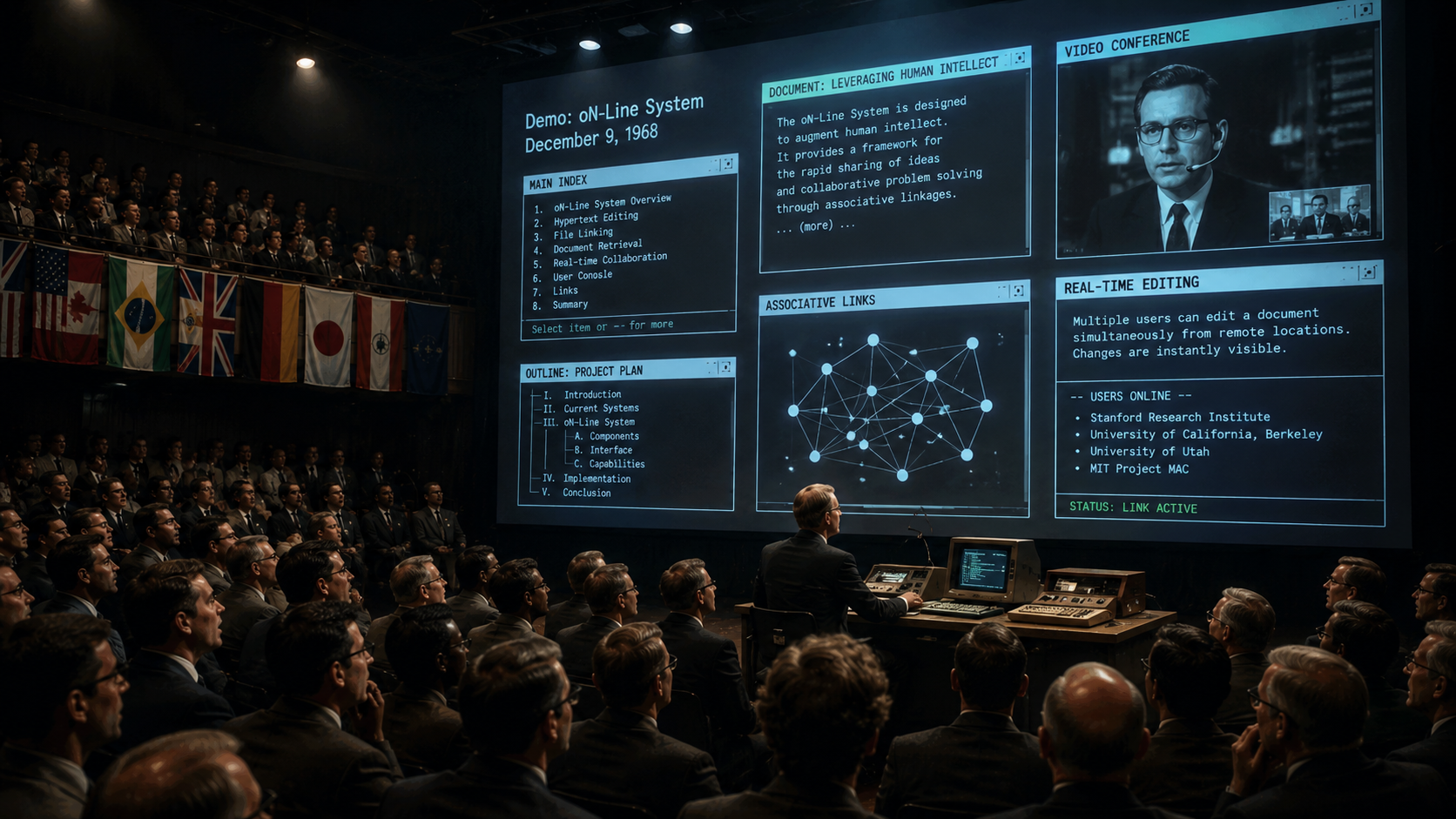
Sometimes the future arrives quietly. It does not come with explosions, flying cars or impossible cities. It appears through small signals that, for a few moments, almost nobody fully understands. That is exactly what happened in December 1968, when Douglas Engelbart stepped onto a stage in San Francisco in front of more than a thousand engineers and began a demonstration that seemed to belong to another century. Digital windows appeared on the screen, along with video calls, interactive documents, file links and real-time collaboration systems. At that moment, the internet did not yet exist. Neither did the personal computer, nor the major technology companies that now dominate the planet.
And yet many of the conceptual foundations of the digital world were already there. What made the event extraordinary was not any single device. The real revolution was the way knowledge itself was being reimagined. Engelbart understood something decisive long before most people did; the great challenges of the future would become too complex to solve through isolated disciplines or rigid structures. For centuries, we organized information as if knowledge were a perfectly ordered library. But reality behaves more like a dynamic network of relationships, connections and constantly shifting patterns. The advantage was no longer simply about knowing more things. It was beginning to depend on connecting them better. That intuition would quietly transform the way we work, learn and collaborate, eventually reshaping the structure of contemporary society itself.
That idea had been developing silently for decades. In 1945, Vannevar Bush imagined the Memex, a machine capable of connecting information through associations similar to those of the human mind. Later, Ted Nelson developed the concept of hypertext and began thinking about documents as interconnected nodes within a living system of relationships. The logic behind it was deeply human; people do not think in straight lines. They think by linking memories, intuitions and patterns. One idea activates another seemingly distant one and, suddenly, an unexpected connection emerges.
Decades later, Gregory Bateson pushed this intuition even further by arguing that intelligence does not reside solely inside the individual, but also within the relationships connecting organisms, contexts and entire systems. Thinking means detecting invisible structures capable of linking elements that initially appear unrelated. This helps explain why some people are able to interpret change before others do. Not necessarily because they possess more information, but because they can perceive relationships that others have not yet connected. Creativity, innovation and even many strategic decisions work exactly this way. They do not emerge solely through the accumulation of data, but when apparently disconnected pieces begin to acquire meaning within a larger structure.
Science fiction had been exploring this transition long before it became part of everyday life. In Snow Crash, Neal Stephensonimagined societies where information, language and digital reality fused into immersive networks capable of reshaping human perception. The interesting aspect was not simply the metaverse or the technology itself. What mattered was the deeper intuition; networks would eventually transform the way people build identity, distribute knowledge and perceive reality. Decades earlier, Isaac Asimov introduced a similarly powerful idea in Foundation. Psychohistory made it possible to anticipate the behavior of entire civilizations by identifying collective patterns invisible to isolated individuals. Asimov understood something fundamental; when millions of people interact inside complex systems, dynamics emerge that cannot be understood from a fragmented perspective.
More recently, Interstellar explored another complementary dimension. In that story, the most important connections were not physically visible. Time, gravity and memory appeared intertwined within hidden structures that could only be understood by radically expanding perspective. Deep transformation never occurs only through technology. It happens when the way we interpret relationships between things changes. And perhaps that is one of the defining shifts of our era. For decades, we believed knowledge depended mainly on specialization and accumulation. Today we are beginning to understand that intelligence also depends on the ability to navigate complex networks, integrate disciplines and build bridges between apparently disconnected ideas.
This transition is especially visible in the present. Climate change, artificial intelligence, biotechnology, energy, cybersecurity and digital governance are profoundly interconnected problems. None of them can be understood through a single discipline alone. Complexity forces us to develop transversal thinking. Innovation no longer emerges only from isolated laboratories. It emerges from ecosystems where scientists, designers, artists, strategists and technologists combine different perspectives and generate unexpected connections. Historically, some of the most creative environments worked precisely this way; Renaissance Florence, Bell Labs or Silicon Valley during certain periods all shared this ability to merge seemingly separate worlds.
Engelbart himself embodied exactly that logic. He did not work only in computer science. He combined cognitive psychology, interaction design, organizational theory and information architecture. What mattered was not each discipline individually, but what emerged once they started connecting. Decades later, sociologists such as Manuel Castells would explain how contemporary societies increasingly evolve toward distributed structures where information circulates through dynamic connections rather than rigid hierarchies. And mathematicians such as Albert-László Barabási would demonstrate that many biological, technological and social networks share similar structural properties. Certain nodes acquire disproportionate importance because they concentrate connections capable of reorganizing entire systems.
However, this new reality also introduces important tensions. Never before have we had access to so much information and, at the same time, never has it been so difficult to determine what truly deserves our attention. Hyperconnectivity creates a strange paradox; the more content circulates, the harder it becomes to construct meaning. We live surrounded by signals, but that does not guarantee understanding. In fact, it often produces the opposite; saturation, fragmentation and constant noise. Here a fundamental distinction appears. Valuable connections do not emerge simply through the accumulation of data. They require judgment, context and interpretative capacity.
That is why the augmented intelligence imagined by Engelbart was never about replacing human thought through automation. It was about expanding our capacity for understanding without destroying intellectual autonomy. This issue becomes especially relevant in the age of artificial intelligence. Current systems can detect patterns invisible to an individual mind and process massive amounts of information, but human judgment is still necessary to decide which connections truly matter and what meaning should be assigned to what we discover. In a world saturated with information, the difference will no longer belong only to those who know more. It will belong to those capable of detecting meaningful relationships within complexity. Because many times the future does not appear when an entirely new idea emerges. It appears when someone manages to connect things that previously seemed unrelated.