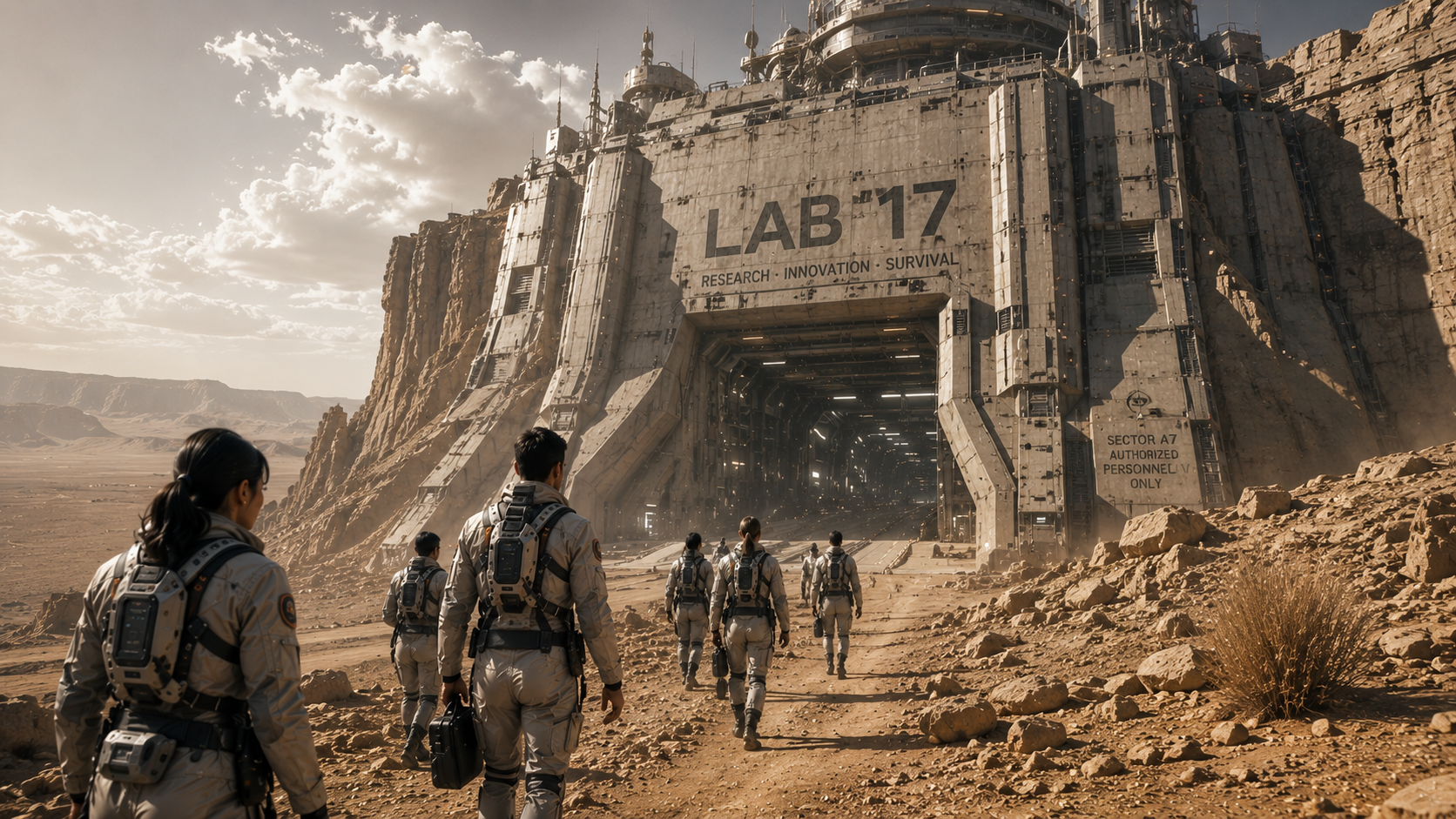


ANTICIPATE SCENARIOS
Imagining possibilities can change how we build the present

In 1975, George Lucas faced an unusual problem. He had imagined a film requiring spaceships, worlds, camera movements and visual effects that the available techniques and equipment could not produce as he needed. He could reduce the project’s ambition to fit existing tools or try to create what was still missing. He chose the latter. To develop the effects for Star Wars, he created Industrial Light & Magic. He had imagined something he could not yet make, and that vision began to show him what he needed to build.
That decision initially solved a cinematic problem, but its consequences went much further. Around Lucasfilm, specialised capabilities emerged in visual effects, sound, video games and other forms of production and entertainment. Industrial Light & Magic, the future Skywalker Sound and Lucasfilm Games, later LucasArts, would become part of an ecosystem that grew for decades. Star Wars also expanded into new films, series, books, comics, video games and experiences. One initial possibility had begun to open others that were not fully defined when the project began.
Roger Bannister experienced something similar in a very different field. For years, running a mile in under four minutes had been an extraordinarily difficult sporting barrier. Bannister turned that possibility into a specific scenario and organised his preparation around it, working on training, pace and strategy. In 1954, he broke the four-minute barrier. A representation of the future had helped organise effort in the present, without guaranteeing the outcome.
Sara Blakely followed another path. She was selling fax machines door to door when she began experimenting with a garment she could not find on the market. She had no detailed map of the company she would eventually build. The initial idea generated new possibilities as she progressed. Her journey shows that anticipation does not mean designing a rigid future. We can imagine how something might evolve without knowing exactly what it will become.
Science fiction has long played with this ability. It does not need to predict the future accurately to be valuable. It can alter a technology, a form of organisation or our relationship with machines and explore what might happen next. The Star Wars universe offers an extraordinary example. Lucas began to build a galaxy populated by planets, species, technologies, cultures, institutions and different ways of life. Film, literature, animation, video games and immersive experiences later explored new parts of that universe. Science fiction can thus function as a laboratory for scenarios, a space where we can mentally inhabit possibilities that do not yet exist.
Minority Report takes this question in another direction. The story imagines a society capable of knowing certain events before they occur and immediately raises a problem: what happens when we treat a future possibility as if it were inevitable. The question goes beyond science fiction. In our own lives, we can also become trapped by a single expectation of what will happen. Anticipating does not mean deciding in advance what the future will be but expanding the number of futures we can consider.
This distinction lies at the heart of scenario thinking. Pierre Wack, through his work at Shell, contributed to the development of modern scenario planning by showing that its usefulness did not lie in predicting exactly what would happen, but in broadening the perception of those who had to make decisions. When uncertainty exists, exploring several plausible futures can be more useful than relying on a single forecast. The question is no longer simply what will happen, but something more fruitful: what might happen and what would it mean for us.
Psychology has explored a similar idea through personal identity. Hazel Markus and Paula Nurius developed the concept of possible selves. Our identity is not shaped solely by who we believe we are today. We also construct representations of the people we might become, of who we would like to become and of who we fear becoming. These possible futures can influence our motivation and the decisions we consider reasonable in the present.
Daniel Gilbert and Timothy Wilson studied another related capacity, prospection, which allows us to mentally represent future events before experiencing them. We constantly simulate possibilities. We imagine how a conversation might unfold, what would happen if we changed jobs, what it would be like to live somewhere else or how far a project might go. Our minds can rehearse futures before they exist, although these simulations are not predictions and need not come true.
But imagining something intensely does not make it happen. Gabriele Oettingen has shown that positive fantasies, when disconnected from the demands of reality, can even be associated with less subsequent effort. Her work on mental contrastingproposes confronting the desired future with present obstacles. Imagination becomes more useful when the future possibility meets present reality. We can then ask what separates us from it and what we can do now.
Peter Gollwitzer took this logic towards action through implementation intentions. Anticipating a situation and deciding beforehand how we will respond can help turn an intention into behaviour when that situation arises. The logic is simple: if a particular circumstance occurs, I will act in a particular way. We do not know whether it will happen, but we can prepare. A scenario stops being merely an image when it begins to change our decisions.
Our lives do not depend exclusively on us. Other people decide, technologies evolve, contexts change and unexpected events can completely alter our plans. John Krumboltz and other researchers developed the concept of planned happenstance to explain how we can increase our ability to take advantage of some of these unforeseen situations. Curiosity, flexibility and openness can help us turn certain accidents along the way into opportunities. Chance continues to exist; our response to it does not have to be random.
This allows us to address a particularly intriguing question: luck. There is no solid evidence that imagining a future causes destiny to produce it. But considering possibilities can change what information we seek, whom we talk to, what capabilities we develop and what opportunities we are able to recognise. An encounter may be entirely accidental, but perhaps we only understand its importance because we had previously imagined a related possibility. We do not control the appearance of many opportunities, but we can expand our ability to recognise them.
Consider, for example, someone writing a story today. The most obvious scenario might be publishing a book. But they might also imagine that one day the story could become a film, a series, a video game, an art exhibition, an educational experience or a social initiative. None of those futures is guaranteed and perhaps none will happen. Yet considering them may change present decisions about languages, rights, collaborators, technologies or partnerships. Imagination has not created the future; it has expanded the map from which we make decisions.
The same applies to our lives. Knowledge acquired to solve a problem may become a profession years later. Research may generate a company. An experience may become a book. We can also imagine less favourable scenarios: a technology that changes our sector, a project that fails or someone else’s decision that alters our plans. Anticipation is not simply about visualising what we want. Thinking in scenarios means broadening our view to include what might force us to change direction.
George Lucas could not have known in 1975 all the forms that the galaxy he was trying to bring to the screen would eventually take. Some possibilities were pursued, others emerged over time, and many depended on people, technologies and circumstances impossible to foresee. What matters is that he did not limit what he could imagine to what already existed. When the present did not contain everything, he needed, he was able to think beyond its limits.
Nor can we know which paths will eventually open before us. Anticipating scenarios does not mean guessing which one will be right or persuading destiny to fulfil our wishes. It means exploring possibilities, recognising obstacles, preparing responses and remaining alert to what we never anticipated. The future will remain uncertain, but the broader our map of possibilities, the better prepared we will be to find our way when it arrives. That is why we should anticipate scenarios.