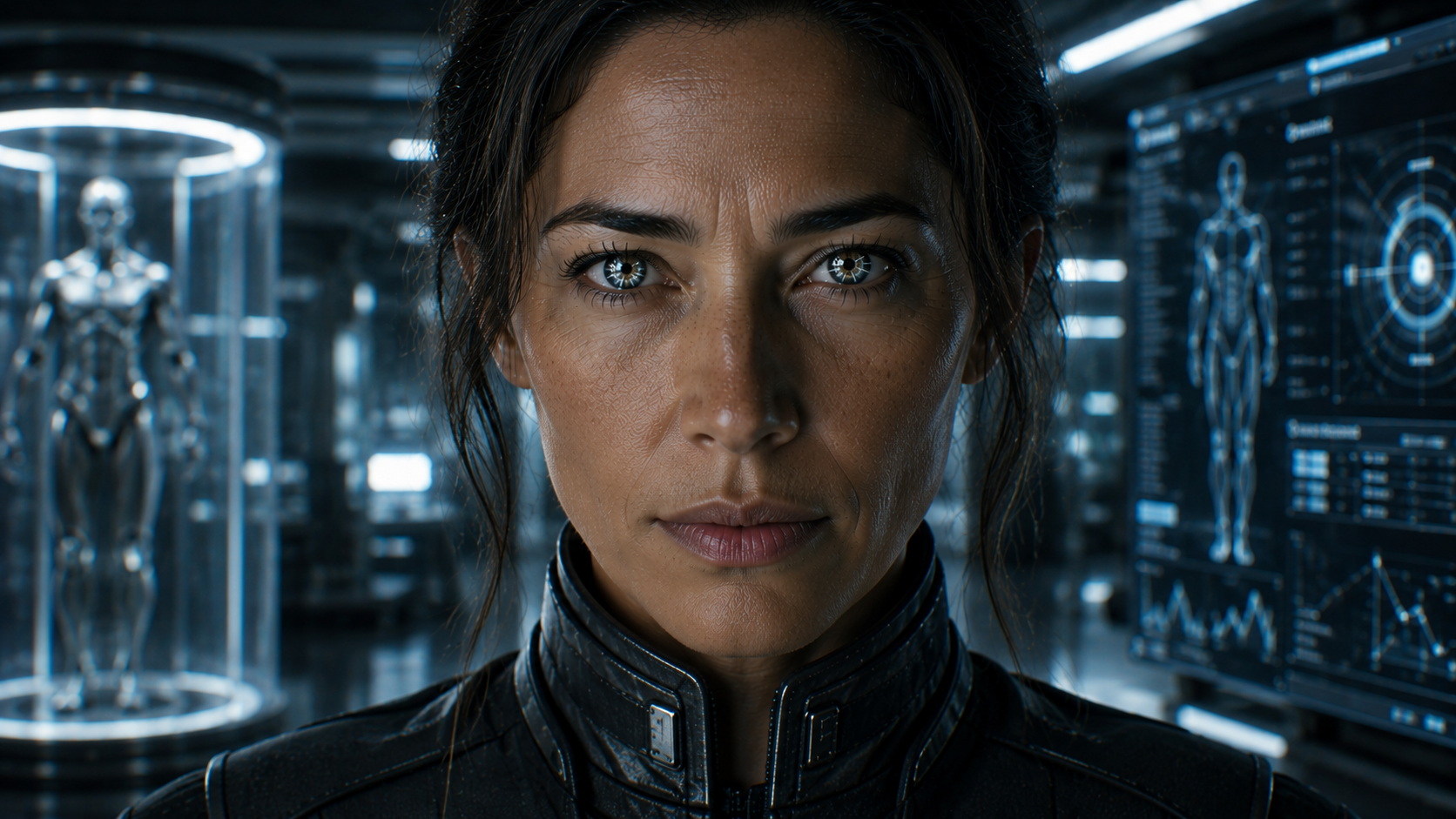


THE LIMITS OF PERCEPTION
Reality does not change. The frameworks through which we interpret it do
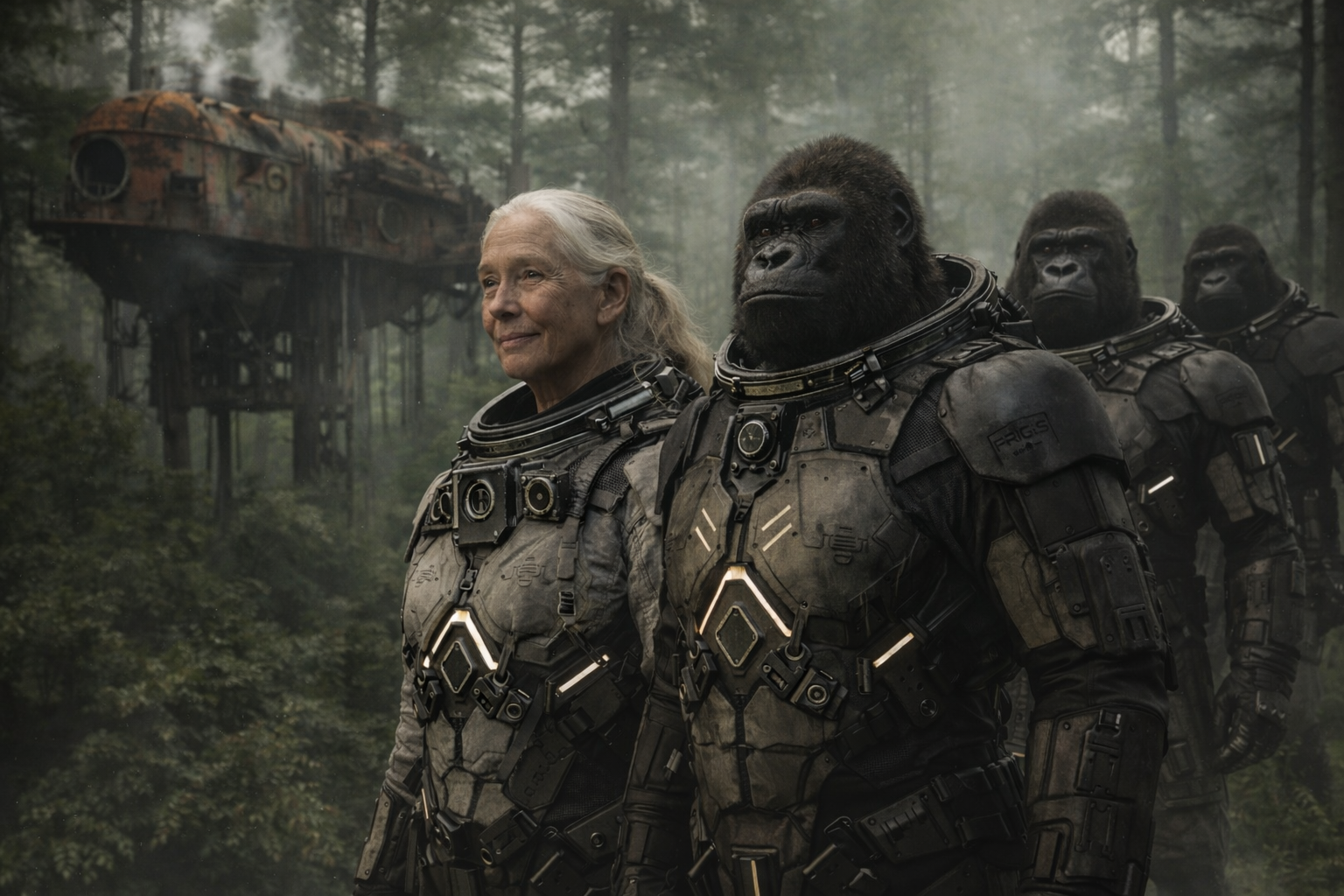
An apparently simple scene forced a reconsideration of one of the most deeply rooted ideas in 20th-century science. In the forests of Gombe, a chimpanzee selected a branch, carefully stripped off its leaves, and inserted it into a termite mound to extract food. The gesture was neither impulsive nor random. It required sequence, intention, and adjustment. A few meters away, Jane Goodall observed the behaviour with sustained attention, aware that something did not quite fit within what had until then been considered possible.
For decades, the scientific community had assumed that the use and manufacture of tools were exclusively human capabilities. This was not a provisional hypothesis, but a conceptual boundary that defined the difference between our species and the rest of life. That framework did not emerge from a single observation, but from an accumulation of knowledge that appeared coherent, stable, and sufficient to explain reality.
The scene, however, introduced an anomaly. Not because the animal’s behaviour was extraordinary, but because it could not be explained within the existing model. The chimpanzee was not improvising. It was using an instrument to modify its environment and achieve a specific outcome. What was being questioned was not the observed fact, but the structure that had kept it invisible.
This is where the real rupture occurs. No new phenomenon appears, but a new way of interpreting it. The difference is subtle, yet decisive. Reality has not changed. What changes is the framework through which it is observed. And when that framework shifts, what once seemed evident can suddenly appear incomplete.
The image is powerful because it forces us to accept something uncomfortable; even the most robust systems of knowledge can contain blind spots. And, above all, because it introduces a deeply human experience: recognizing that something does not quite fit before being able to fully explain it.
This pattern is not an exception. It is a constant in the history of knowledge. For long periods, disciplines evolve within frameworks that organize reality in a coherent way. They work, produce results, and generate confidence. But they also delimit what can be perceived and interpreted. Thomas Kuhn explained that these frameworks, which he called paradigms, do not merely answer questions; they define which questions are even possible. When they stop fitting, adding more information is not enough. It becomes necessary to change the way we interpret.
This shift does not happen automatically. Evidence can be present for years without being recognized if there is no language to make sense of it. At an individual level, something similar occurs. Daniel Kahneman showed that our minds do not process reality in a neutral way. They simplify, filter, and complete information through shortcuts that allow us to act quickly but also introduce systematic distortions. We do not access reality directly. We access a construction.
This phenomenon has not been explored solely through science. It has also been addressed from a less obvious, yet equally relevant domain: fiction. Not as escapism, but as a space where the limits of reality can be stretched without the immediate constraints of empirical proof. In this sense, certain science fiction narratives function as conceptual laboratories.
In The Matrix, the rupture does not occur when the environment changes, but when the protagonist understands that what he perceived as reality was an interface designed to be interpreted as such. Nothing physically changes in that moment. What changes is access to interpretation. The stability of the world was only apparent because it was sustained by an unquestioned framework.
In Arrival, the transformation does not come from external technology, but from learning a new language. As the protagonist acquires that linguistic structure, her experience of time changes. Time ceases to be linear. Reality itself does not change, but the structure through which it is interpreted does.
Some lesser-known narratives take this idea even further. In Dark City, the city, memory, and identity are continuously reconfigured without the inhabitants being aware of it. Subjective experience maintains a sense of continuity, yet the frameworks sustaining it are constantly shifting. What is perceived is not false, but it is not complete.
In The Adjustment Bureau, everyday reality is shaped by invisible rules that condition decisions and possible paths. What appears as individual choice may be influenced by structures that do not belong to conscious perception. Freedom does not disappear, but it is not as transparent as it seems.
These narratives do not replace scientific knowledge. They complement it. They allow us to explore scenarios where frameworks shift radically, revealing something that usually remains implicit in everyday life: we live within systems of interpretation that we rarely question.
In this context, perception cannot be understood as an improvement of a single sense, but as a capacity for interpretation. Human beings do not perceive the world in a single way. When one channel is reduced or absent, others can reorganize and reach extraordinary levels of precision. The case of Daniel Kish illustrates this. Blind since childhood, he has developed a system of echolocation through tongue clicks that allows him to navigate complex environments. He does not perceive the environment in the conventional sense, yet he interprets it with remarkable functional resolution.
This example reveals something essential. Perception is not passive reception, but an active process of construction. Gregory Bateson proposed that the mind does not reside solely within the individual, but in the patterns of relationships that connect elements within a system. To perceive is not simply to receive information, but to integrate it into structures of meaning.
When this capacity emerges in scientific practice, its effects can be transformative. Barbara McClintock observed for years a genetic behaviour that did not fit the dominant model. Her findings were rigorous, yet they could not be interpreted within the existing framework. For decades, her work was ignored. Only when biology expanded its understanding did her discovery become evident. The evidence did not change. The ability to interpret it did.
This same dynamic can be observed in something as immediate as perception itself. Edwin Land demonstrated that what we experience is not a fixed property of objects, but the result of interpretative processes carried out by the brain. Experience is not a direct copy of the external world, but a reconstruction.
Contemporary research has taken this idea even further. Donald Hoffman argues that evolution has not favoured the perception of reality as it is, but the construction of interfaces that are useful for interacting with it. What we experience is not a faithful representation of the world, but an adaptive simplification.
From this perspective, reality does not present itself directly. It is structured through systems that determine what becomes accessible and what remains outside our interpretation. These frameworks allow efficient action, but they can also exclude relevant elements without being noticed.
At that point, the difference lies not in having more information, but in the ability to reorganize it. This has direct implications for decision-making. Many decisions fail not because of a lack of data, but because of the rigidity of the framework used to interpret it. Options that do not fit are discarded, signals that seem irrelevant are ignored, and conclusions that confirm prior assumptions are reinforced.
Revising that framework requires a different kind of effort. It is not only about thinking better, but about questioning from where we are thinking. The story of Jane Goodall condenses this dynamic with exceptional clarity. She did not transform nature. She transformed the way we interpreted it.
In complex environments, this capacity becomes a decisive advantage. Not because it guarantees accuracy, but because it reduces the risk of remaining trapped in interpretations that no longer describe what is happening. The difference is not in perceiving more, but in being able to interpret differently. And, in many cases, that shift begins exactly like this: with the persistent feeling that something does not quite fit.